



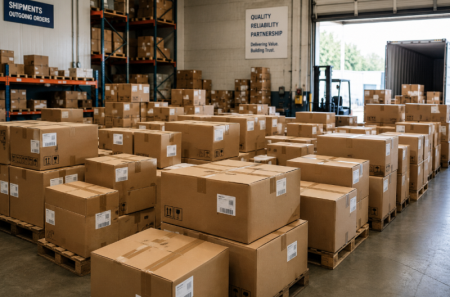
ITF-14 is a GS1 barcode symbology commonly used to identify cases, cartons, and other trade-item groupings in distribution environments. It is especially suitable for direct printing on corrugated fiberboard, where symbol size, bearer bars, quiet zones, contrast, and print quality all affect scanning performance.
An online Interleaved 2 of 5 generator can create a barcode image, but the final printed symbol must still meet applicable GS1 and trading-partner requirements. A generated image alone does not assign a GTIN confirm GTIN ownership, validate packaging hierarchy, or certify print quality.
This guide explains ITF-14, its relationship to GTIN data, and the key design requirements for reliable logistics scanning.

What Is the Difference Between GTIN Data and ITF-14 Barcode Symbology?
GTIN and ITF-14 are related, but they are not interchangeable.
A GTIN is the product identification number assigned to a trade item. An ITF-14 is a barcode symbology used to encode GTIN data in a 14-digit format.
The Data: GTIN in 14-Digit Format
A GTIN uniquely identifies a specific trade-item configuration. For example, a case of 12 units and a case of 24 units may require different GTIN assignments if they are different trade items for ordering, inventory, shipping, or receiving purposes.
The quantity is maintained in product master data. It cannot be decoded directly from the GTIN digits.
A newly assigned GTIN-14 for a fixed-measure trade-item grouping typically includes:
• Indicator digit: For fixed-measure trade-item groupings, digits 1 through 8 can be used to create distinct GTIN-14s associated with the same child item. The digit does not define a universal carton quantity or packaging level.
• GS1 Company Prefix: The prefix licensed to the organisation responsible for assigning the GTIN.
• Item reference: The reference assigned to the specific trade-item configuration.
• Check digit: The final digit, calculated using the GS1 Modulo 10 algorithm.
ITF-14 always encodes 14 numeric digits. It may encode a GTIN-14 directly, or it may encode a GTIN-12 or GTIN-13 after the shorter GTIN has been zero-padded to a 14-digit format.
The Symbol: ITF-14
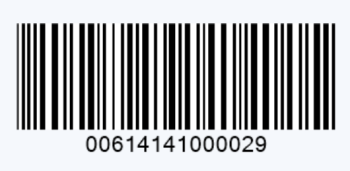
ITF-14 is the GS1 implementation of Interleaved 2 of 5 for trade-item groupings. It is a numeric-only linear barcode commonly used on cases and cartons that are not intended for retail point-of-sale scanning.
ITF-14 carries GTIN data only. It cannot encode letters, lot numbers, serial numbers, expiration dates, or other variable attributes.
If your label must include variable information, use GS1-128. GS1-128 uses Application Identifiers to encode a GTIN together with data such as batch or lot number, serial number, production date, or expiry date.
A Note on Legacy Terminology: What About EAN-14?
"EAN-14" and ITF-14 refer to different concepts, and "EAN-14" is a legacy term that frequently appears in older barcode documentation.
In current GS1 standards:
• Use GTIN-14 for the 14-digit trade-item identification number (the underlying data).
• Use ITF-14 for the Interleaved 2 of 5 barcode symbology used on cases and cartons (the printed symbol).
ITF-14 is the printed barcode symbol, while GTIN-14 is the data it encodes. ITF-14 can also encode GTIN-12 or GTIN-13 after they are formatted to 14 digits with leading zeros. Therefore, “EAN-14” should not be treated as a separate barcode type or a direct alternative to ITF-14.
How Does ITF-14 Compare to GS1-128 and UPC-A?
Choosing the right barcode depends entirely on the item being marked and the environment where it will be scanned.
Feature | ITF-14 | GS1-128 | UPC-A |
Primary use | Cases and cartons in distribution | Logistics labels with GTIN and additional GS1 data | Retail point-of-sale |
Data capability | GTIN in 14-digit format | GTIN plus GS1 Application Identifier data | GTIN-12 |
Variable data | No, GTIN only | Yes, such as lot, expiry, or serial number | No |
Typical application | Fixed-measure trade-item groupings | Traceability and logistics labels | Consumer retail units |
Direct corrugated printing | Commonly suitable | Depends on the printing process and application | Usually not preferred for case marking |
ITF-14 vs. UPC-A
UPC-A is primarily used to encode GTIN-12 for retail point-of-sale applications. Although a UPC-A symbol may also be scanned in other supply-chain settings, it is generally not the preferred barcode for direct printing on corrugated shipping cases.
ITF-14 is commonly selected for outer cases and cartons because it is well suited to corrugated-material printing and non-POS distribution processes.
ITF-14 vs. GS1-128
Use ITF-14 when the case or carton only needs to carry a GTIN.
Use GS1-128 when a logistics label must carry a GTIN together with additional information, such as:
• Batch or lot number
• Serial number
• Production date
• Best-before date
• Expiration date
• SSCC for a logistics unit
The need for variable data depends on your traceability process, applicable regulations, and trading-partner requirements.
What Are the Official GS1 Quiet Zone and Size Requirements for ITF-14?
The final ITF-14 size should be selected based on the printing method, carton material, scanning environment, and trading-partner requirements.
What Are ITF-14 Bearer Bars?
ITF-14 symbols use bearer bars to support reliable printing and scanning. When printed directly on corrugated fiberboard, the barcode should be enclosed by a complete four-sided bearer box. This helps equalize printing pressure and reduces the risk of bar-width distortion during plate-printing processes.
For labels and on-demand printing methods, top and bottom bearer bars are generally used without the vertical sides. Bearer bars also help reduce the risk of short scans or partial reads when a scanner enters or exits through the top or bottom of the symbol.
X-Dimension and Bar Height
The X-dimension is the width of the narrowest bar or space in the symbol.
• At 100% magnification, the X-dimension is 1.016 mm.
• The general permitted X-dimension range is 0.495 mm to 1.016 mm.
• The bar height should remain 31.75 mm.
For direct printing on corrugated fiberboard, particularly in automated distribution environments, use an X-dimension of at least 0.635 mm where possible. Smaller symbols may be suitable for labels or high-quality substrates, but they should not be assumed suitable for direct corrugated printing.
Larger symbols within the permitted range generally provide greater tolerance for ink spread, print variation, and scan-distance demands.
Quiet Zones
A quiet zone is the clear area immediately to the left and right of the barcode. It allows the scanner to identify where the symbol starts and ends.
• Maintain a quiet zone of at least 10 times the X-dimension (10X) on both sides.
• At 100% magnification, this equals 10.16 mm (0.40 in) on each side.
• Do not place text, graphics, carton folds, tape, or other marks inside the quiet zones.
Need help creating your barcode?
For a step-by-step guide on setting up your GTIN-14 number and using our free barcode generator tool, please read our foundational article: How to Generate an ITF-14 Barcode.
