



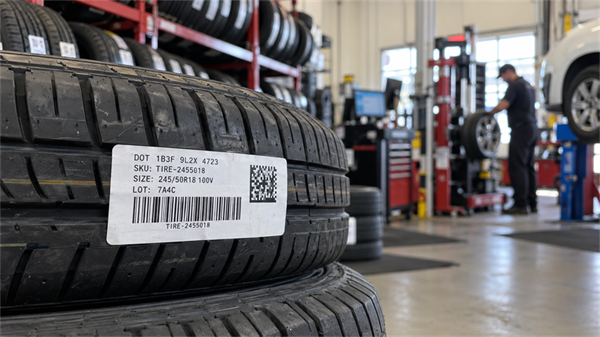
Tires may look simple from the outside, but their molded markings, human-readable identification numbers, and applied barcode labels carry critical safety, production, and inventory data. Manufacturers, distributors, and auto repair shops all rely on these identifiers to track tires from the factory floor to the service bay.
Whether you manage an independent tire shop or simply want to understand tire supply chains, this guide explains how tire barcodes work and how to streamline local tire inventory management.
Vulcanization-Resistant Bead Labels vs. Post-Cure Inventory Labels
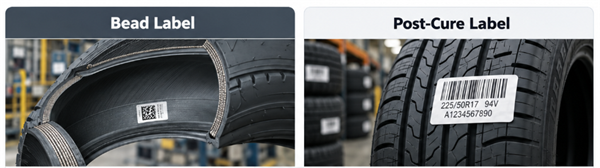
Not all tire labels serve the same purpose. The tire industry broadly separates identification labels into two categories based on when and where they are applied.
Note: "Pre-cure" labels are applied to uncured rubber before the tire is molded and vulcanized, while "post-cure" labels are placed on finished tires for shipping, warehousing, retail, and inventory management.
Feature | Vulcanization-Resistant Bead Label | Post-Cure Inventory or Retail Label |
Application Stage | Applied to the uncured "green tire" before molding and vulcanization | Applied after curing for warehouse distribution, retail, or shop management |
Primary Purpose | Factory tracking, manufacturing traceability, and quality control | Inventory counting, receiving, order picking, and point-of-sale (POS) checkout |
Durability Requirement | Engineered to withstand intense molding heat, often up to 200–210 degrees Celsius, as well as pressure | Designed for ambient storage, handling, UV exposure, and adhesion to tread or other tire surfaces |
Typical Symbology | High-density Data Matrix or compact 1D barcodes | |
Typical Location | Tire bead, inner wall, or another specified bead-zone location | Tire tread surface, sidewall sticker, or outer packaging |
Because the tire bead sits tightly against the wheel rim, it experiences minimal direct contact with the road. When properly applied during manufacturing, bead labels can remain readable throughout production and subsequent inspection processes.
What Information Is Encoded in DOT Markings & Tire Barcodes?
A common area of confusion is whether federal DOT numbers are automatically barcodes. They are not.
Note: The DOT Tire Identification Number (TIN) molded on a tire sidewall is a mandatory human-readable marking under U.S. law. Any accompanying barcode is an optional tracking tool added by manufacturers or supply chain partners.
1. Deconstructing Current U.S. DOT/TIN Requirements
Under current U.S. National Highway Traffic Safety Administration (NHTSA) regulations for new tires, a standard TIN consists of a 13-symbol sequence:
• Plant Code: A three-symbol code assigned by NHTSA to identify the new-tire manufacturer or retreader.
• Manufacturer's Code: A six-symbol group located between the plant code and the date code. The manufacturer uses it to identify significant tire characteristics or the brand-name owner. Its internal meaning is not necessarily transparent to consumers.
• Date Code (WWYY): A four-digit code identifying the week and year of manufacture. For example, 2326 indicates the 23rd full calendar week of 2026.
Note: Older regulatory references or standards for retreaded tires may mention a four-group structure with a separate tire size code. Modern U.S. rules for new tires consolidate product attributes into the six-symbol Manufacturer's Code.
2. Standardizing Data with the GS1 System
When supply chain partners need standardized tracking across different warehouse or inventory systems, they often encode GS1 Application Identifiers (AIs) into 1D or 2D barcodes:
• (01) GTIN: Global Trade Item Number used for standardized product identification.
• (10) Batch/Lot Number: Identifies a specific production batch or lot.
• (21) Serial Number: Assigns a unique ID to an individual tire when paired with a GTIN.
Barcodes vs. RFID: Which Is Better for Tire Tracking?
Warehouse managers frequently evaluate both optical barcodes and radio frequency identification (RFID) systems.
• 1D & 2D Barcodes: A reliable and economical option for tire identification. Barcode scanners can quickly decode standard linear symbols such as Code 128 or 2D symbols such as Data Matrix, provided the label has sufficient contrast and adequate quiet zones.
• RFID Tags: RFID chips can be embedded in tires or attached as specialized tags. They enable scanning without direct line of sight and can support multiple-item reads, but they typically require a higher upfront investment in readers, middleware, and process integration.
For many independent tire dealers, standard barcode labels offer a practical balance of cost, setup simplicity, and everyday scanning efficiency.
Practical Inventory Workflows for Independent Tire Dealers & Auto Shops
Many shop owners find that their barcode scanner can successfully read a manufacturer's tread label, but the POS system still returns an error.
Note: In many cases, the problem is not the barcode scanner itself. Instead, the shop's POS or inventory software does not recognize the manufacturer's internal code until that code is mapped to a local product record.
To set up an efficient tire inventory workflow, follow these steps:
1. Map Supplier Data to Local SKUs
Create a master lookup table in your inventory software that links supplier barcodes or part numbers to your own internal SKU records.
2. Generate Custom Shop Barcodes
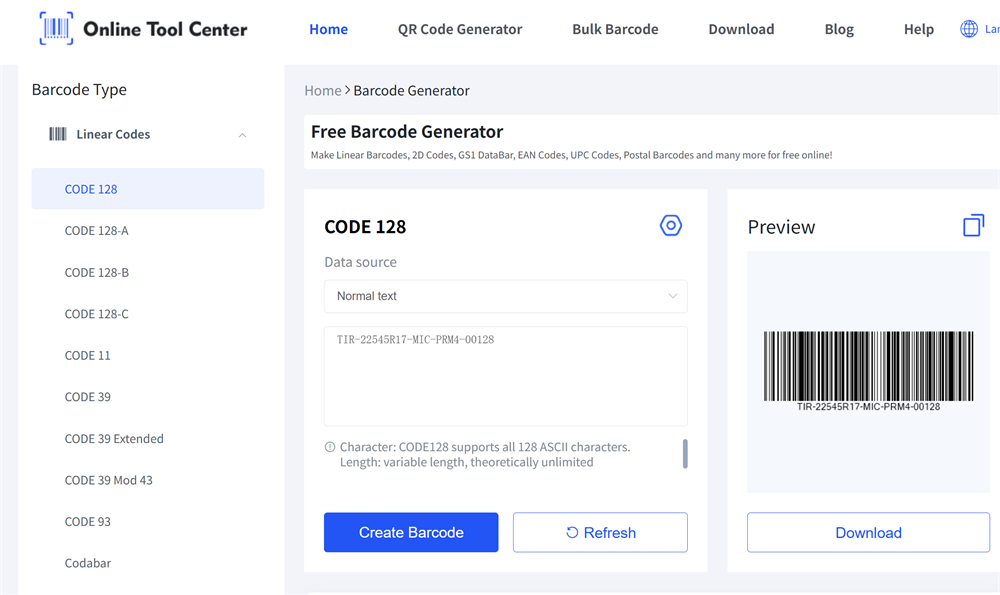
If incoming tires do not have usable barcodes, print internal labels using standard barcode symbologies:
✔️ Code 128: Well suited to standard 1D labels used on tread surfaces, storage racks, or warehouse locations.
✔️ Data Matrix or QR Code: Useful when you need to fit more detailed product identifiers into a compact label area.
Easily design and print custom tire barcodes using our free Online Barcode Generator. Try now!
3. Store Dynamic Information in the System
Avoid encoding frequently changing information such as selling price, unit cost, or storage location directly into the physical barcode. Instead, keep those details in your shop software and link them to a static SKU or product ID.
Note: Printing prices or bin locations directly on barcode labels can force you to relabel tires whenever prices change or inventory is moved to a different storage location.
Tire identification combines heat-resistant bead labels, mandatory DOT/TIN markings, and optional post-cure barcodes. While barcodes aren't federally required, smart labeling and inventory workflows help shops map supplier codes, print custom labels, and track tires accurately from factory to service bay.
Frequently Asked Questions (FAQ)
Why is the bead area used for factory tire barcodes?
The tire bead experiences minimal road friction after the tire is mounted on a wheel. Applying a heat-resistant label to the bead before vulcanization allows automated factory systems to track the tire through molding, production, and quality-control processes while reducing the risk of label wear during normal use.
Does federal law require tire barcodes?
No. U.S. federal regulations require human-readable DOT tire identification information on the tire sidewall. Manufacturers may add barcodes or Data Matrix symbols to improve internal manufacturing, logistics, and supply chain tracking, but the barcode itself is not a federally required tire-identification format.
What barcode type works best for custom shop labels?
Code 128 is a practical choice for standard 1D barcode scanners and larger tread or rack labels. If you need a compact label that can hold more data in a small area, Data Matrix or QR Code is usually the better option.
