




For race directors, marathon success depends on efficient operations and clear safety procedures. Two of the biggest challenges are reducing packet pickup bottlenecks and ensuring responders can access critical participant information when needed.
Many events still treat QR codes mainly as marketing tools. In reality, when they are connected to a race registration system, QR codes can become a practical operational layer for check-in, bib assignment, and secure information lookup.
How QR Codes Improve Marathon Packet Pickup Logistics
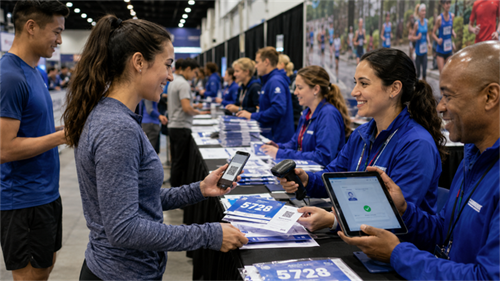
Traditional packet pickup often relies on manually sorting envelopes by name or bib number. That approach can work, but it becomes slower and more error-prone as event size increases, especially when large numbers of runners arrive in a short time window.
A more efficient model uses a registration QR code and a race-day check-in system.
The runner presents a confirmation code on a phone or printed notice, staff scans it, and the system instantly retrieves the participant record. From there, staff can assign the next available bib or confirm the preassigned bib tied to that runner.
This workflow can reduce line congestion, lower the risk of distribution mistakes, and simplify training for volunteers. It also makes it easier to scale packet pickup across multiple stations or time slots.
Reducing Material Waste with Dynamic Bib Assignment
Some race platforms support dynamic bib assignment, where a bib is not permanently tied to a runner until packet pickup. This can be useful for events that want to keep bib inventory flexible and reduce waste from unclaimed packets.
In a dynamic workflow, the runner checks in using a QR code linked to their registration record. Staff then scan or select the next available bib, and the system pairs the participant profile with that bib number in the database.
If the platform also supports timing integration, the bib assignment can be synchronized with the event's chip record.
This approach is especially helpful when registration changes continue close to race day, or when organizers want to avoid printing large quantities of fully personalized bibs in advance. It should be noted, however, that the exact process depends on the race management platform being used.
Securing Runner Safety and Medical QR Code Privacy
Some endurance events choose to place emergency contact details or limited medical notes on race materials. That can be helpful in an emergency, but sensitive health data should never be exposed in a way that is openly readable by anyone who scans or photographs the bib.
A safer model is to use a QR code that points to a secure, access-controlled record rather than printing personal medical data directly on the bib. In this setup, emergency personnel can scan the code and be routed to a protected page that only authorized users can view.
To protect privacy, the system should use role-based access, secure authentication, logging, and expiration controls. Event organizers should also limit the amount of medical data stored and only collect information that is truly necessary for emergency response.
A Recommended QR-Based Workflow for Race-Day Check-In
A practical race-day workflow may look like this:
1. Arrival: The runner arrives at packet pickup with a QR code on their phone or printed confirmation.
2. Verification: Staff scans the code and opens the participant record.
3. Assignment: Staff assigns or confirms the bib number.
4. Synchronization: The bib number and timing record are synchronized in the race system.
5. Safety Integration: If needed, the bib includes a secure emergency QR code that links to authorized medical information.
6. Deactivation: After the event, access to race-specific links can be disabled or expired in bulk.
This model improves throughput without forcing organizers to abandon familiar race-day procedures. It also keeps the focus on operational reliability rather than technology for its own sake.
Balancing Speed and Security in Modern Race Operations
The main advantage of QR-based race operations is not that they replace every existing process, but that they connect registration, packet pickup, bib management, and emergency access into a more controlled workflow. That helps staff work faster, reduces paperwork, and improves the participant experience.
For race directors, the strongest version of the argument is simple: use QR codes where they reduce friction, and use secure systems where participant privacy matters. That combination is more credible, more scalable, and easier to defend operationally.
Ready to Build a Safer, Faster Event?
Use our QR code generator to manage your event check-ins and safety links, allowing you to update or deactivate destinations instantly after the race.

