



Key Takeaways
• GS1 Digital Link is a standard, not a barcode format. It uses existing GS1 identifiers, such as GTINs.
• Its URI can be encoded in 2D barcodes. QR Codes and supported Data Matrix symbols can connect product identification with online information.
• A resolver is not always required. Basic redirects serve one destination, while GS1-conformant resolvers support multiple resources.
• It connects products to digital information. Businesses can link products to details, traceability records, certifications, and other online resources.
What Is GS1 Digital Link?
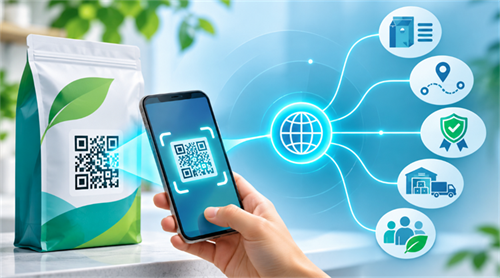
GS1 Digital Link is the GS1 standard for expressing existing identification keys, such as a Global Trade Item Number (GTIN), as web-compatible URIs. It connects an identified product, location, or asset to related online information.
It does not create a new identifier; a GTIN still identifies the trade item. A QR Code carrying it can support retail identification and link shoppers to ingredients, certifications, or traceability details.
How Does GS1 Digital Link Work?
1. Identify the item with a GS1 key, such as a GTIN.
2. Build the URI using GS1 Digital Link syntax.
3. Encode it in a compatible carrier, such as a QR Code or supported Data Matrix.
4. Scan it: A GS1-aware scanner can extract the data; a smartphone can open the URI as a web address.
5. Access related information, typically through a redirect or resolver.
One code can serve supply-chain and consumer needs. GS1-aware retail scanners can process the identifier offline, while a redirect sends shoppers to current information. The product identifier and webpage address are not the same thing.
What Does a GS1 Digital Link URI Look Like?
A GS1 Digital Link URI combines a web domain, GS1 identifiers, and optional product data. This is an illustrative example, not a live product link:
https://example.com/01/09520123456788/10/ABC123?17=270630
Component | Meaning |
https://example.com | Web domain |
01 + GTIN | Identifies the trade item |
10 + ABC123 | Batch/lot number |
17 + 270630 | Expiration date: June 30, 2027 |
Three terms matter: primary identification key (such as a GTIN), key qualifier (such as a batch number), and data attribute (such as an expiry date). A brand can use its own domain; it is not part of the GS1 key. The URI must follow GS1 syntax. GTIN-8, GTIN-12, and GTIN-13 values are padded to 14 digits.
What Are the Official GS1 Digital Link Standards?
GS1 now uses “GS1 Digital Link” for the foundational URI Syntax; Resolver and Compression are companion specifications:
Document | Purpose |
Defines how GS1 identifiers and data appear in web URIs | |
Defines how systems find related online resources | |
Defines a compressed form for certain EPC binary strings |
As of November 2026, these are the latest published versions. The original all-in-one document is now a legacy reference. The GS1 Web Vocabulary is a related technology that gives shared meaning to product data and link types.
Is GS1 Digital Link a QR Code?
No. GS1 Digital Link is a standard for expressing GS1 identifiers in web URIs. A QR Code or supported Data Matrix can carry that URI.
Technology | Main purpose |
UPC/EAN | Carries a product identifier for retail scanning |
Regular QR Code | Stores general data, such as a URL or text |
QR Code with GS1 Digital Link URI | Carries GS1 identification data in a web-compatible URI |
GS1 DataMatrix | Commonly carries GS1 data in element-string syntax |
A regular QR Code stores general data. A QR Code with a Digital Link URI carries GS1 identification data, unlike a GS1 QR Code using element-string syntax.
What Is a GS1 Digital Link Resolver, and Is It Required?
A resolver connects a GS1 Digital Link URI to related online resources. Link types describe each resource; linksets list multiple links in a machine-readable format. A product identifier can link to product details, instructions, certificates, or traceability data.
Is a resolver mandatory? No. A basic one-to-one redirect works without special software. A GS1-conformant resolver is useful when applications need to discover and select multiple resources. Linksets and link types can also work without a resolver.
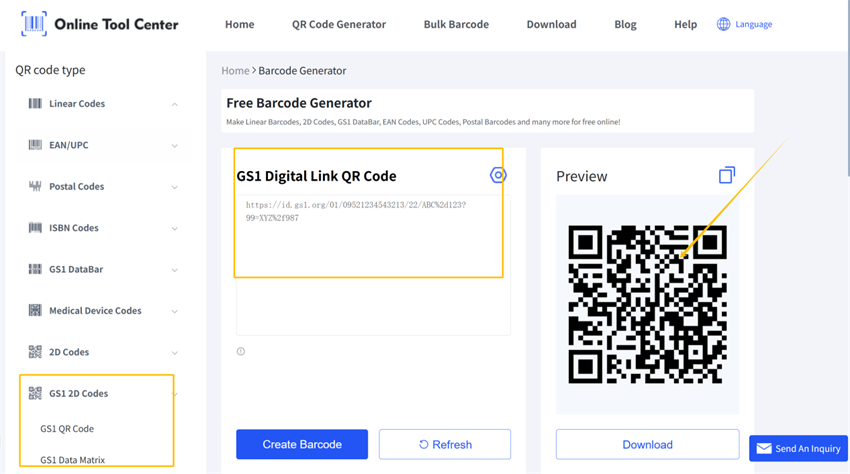
Ready to create a code? Use the our GS1 Digital Link QR Code Generator to makea QR Code from a valid URI.
Where Is GS1 Digital Link Used?
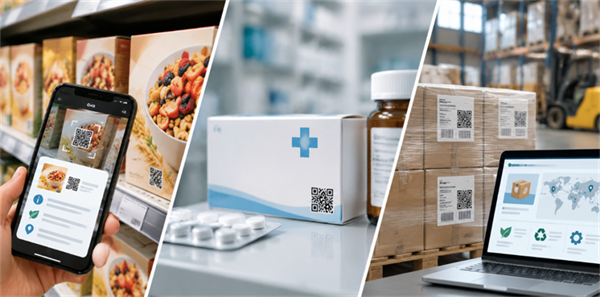
GS1 Digital Link supports many sectors:
• Retail: Product identification and 2D barcode scanning.
• Food and beverage: Batch, expiry, ingredient, and origin information.
• Healthcare: Medicine and medical-device information.
• Supply chain: Product, location, and logistics-unit identification.
• Digital Product Passports: Links to material, sustainability, and lifecycle data.
Want to see how GS1 Digital Link works in a real industry setting? Explore our guide to GS1 Digital Link for Food and Beverage Traceability.
A Digital Product Passport is not GS1 Digital Link; Digital Link can connect users to passport-related information.
How Can GS1 Digital Link Support AI and Search Engines?
Combined with linksets, link types, and the GS1 Web Vocabulary, Digital Link can make product information easier for search engines, knowledge graphs, and AI agents to discover and interpret. GS1 explains this relationship in its Online Technologies guide. This does not guarantee rankings or AI citations. Data must remain accessible, accurate, and attributable.
How Can Businesses Start Using GS1 Digital Link?
1. Obtain GS1 identifiers: Use valid keys, such as GTINs, assigned through the GS1 system.
2. Choose the data: Decide whether you need batch numbers, serial numbers, expiry dates, or other attributes.
3. Create a conformant URI: Follow the current GS1 Digital Link URI Syntax.
4. Set up redirection: Use a simple redirect for one destination or a GS1-conformant resolver for multiple machine-discoverable resources.
5. Generate and test the code: Check URI validity, print quality, and scanning performance.
GS1's Sunrise 2027 ambition aims for retail POS systems worldwide to read both 1D and 2D barcodes by the end of 2027. It does not require every product to use Digital Link. Confirm requirements with retail partners.
Frequently Asked Questions About GS1 Digital Link
1. Can a Business Use Its Own Domain?
Yes, provided the URI follows GS1 syntax.
2. Can a Smartphone Scan a GS1 Digital Link QR Code?
Yes. A smartphone can scan the code and open its URI. Internet access is needed for online content.
3. Is GS1 Digital Link Mandatory for Sunrise 2027?
No. Sunrise 2027 is an industry goal for retail POS 2D barcode readiness, not a rule requiring every product to use GS1 Digital Link.
4. Can GS1 Digital Link Work Without the Internet?
A GS1-aware scanner can extract encoded identifiers without an online lookup. An internet connection is needed to retrieve linked webpages.
5. Is GS1 Digital Link the Same as a Digital Product Passport?
No. A DPP is a digital product record; Digital Link can connect users to its information.
Connecting Products to the Digital World
GS1 Digital Link brings product identification and online information together. From retail scanning and supply chain traceability to consumer engagement and digital product information, it gives businesses a standardized way to connect products with useful digital resources.
The key is to get the identifier, URI, and linked information right. When these elements work together, a simple product scan can become a much more useful digital experience.
